The Silo Saga · The world
The Silo
A buried city of a hundred and forty-four levels, one staircase, and a single window on a dead world.
Hugh Howey has said that the second part of Wool was there to introduce readers to “the star of the books, the silo itself.” This page is about that star: Silo 18, a city dug a hundred and forty-four levels into the earth around a single staircase; the other silos like it; Silo 1, which runs them all; and the world above, which every silo has been taught means death.
The books hand the world out a piece at a time. Wool lives inside one silo and knows only its rules and its single view; Shift goes back to 2049 to show who built the silos and why; Dust takes them apart and walks out past the edge. This page gathers what all three reveal, so it spoils everything, the end of Dust included.
Page references are to the 2013 Simon & Schuster Wool and the 2016 John Joseph Adams/Houghton Mifflin Harcourt Shift and Dust. Where the Apple TV series built its silo differently, the Notes below say so.
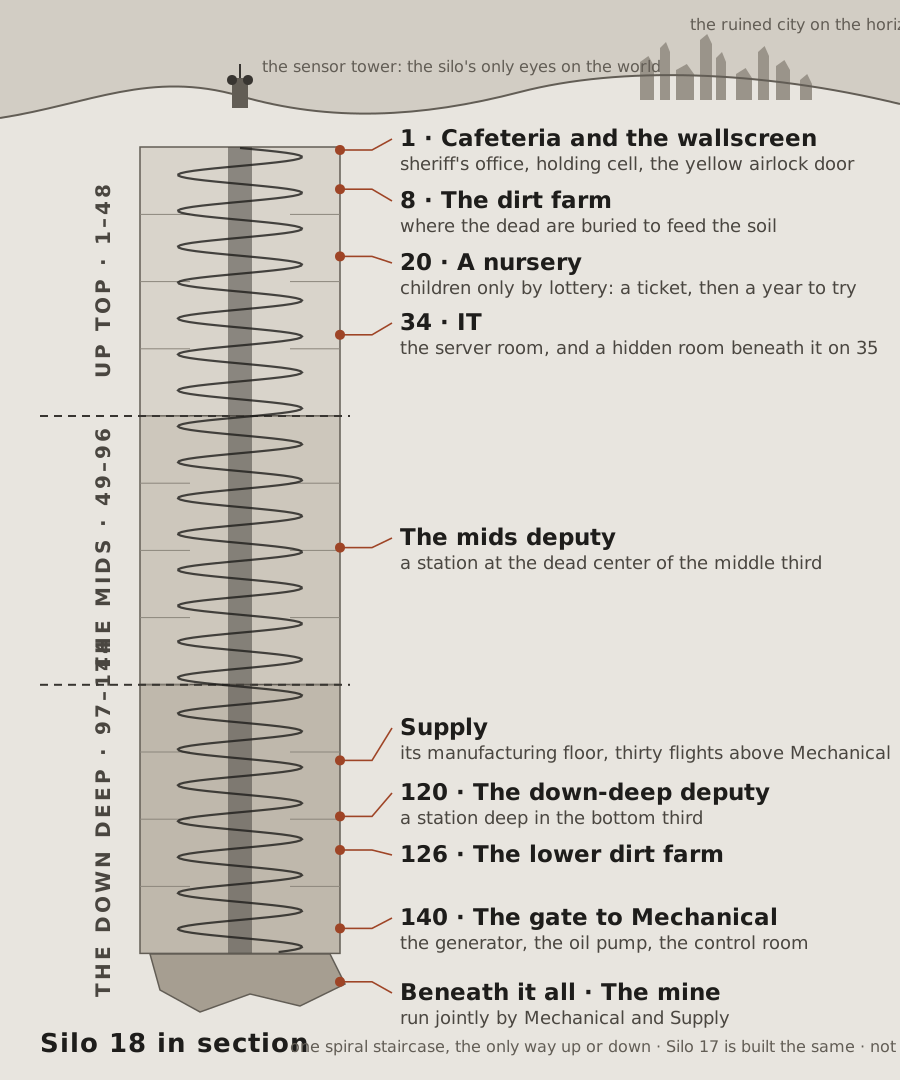
This companion’s own diagram, not to scale, drawn from the levels the books name; in Wool Juliette finds Silo 17 laid out the same way.
One hundred forty-four levels
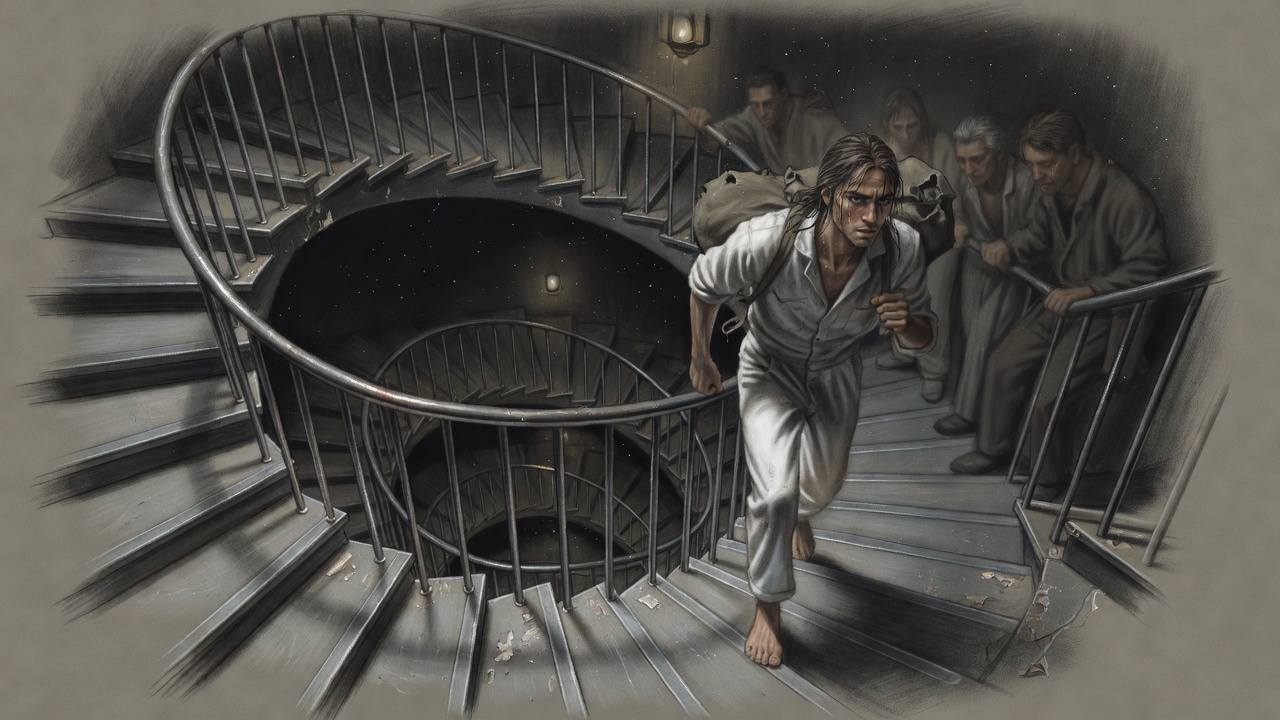
Silo 18 is a shaft sunk beneath a ring of dead hills, a hundred and forty-four levels deep. Each level is a ring of pie-shaped rooms — dormitories, workshops, offices, farms — around a hollow center, and through that hollow winds the one thing that joins them: a great spiral staircase of steel treads, its paint surviving only in the corners and undersides where no boot reaches. There is no lift; in Shift the order handed to its designers is “No lifts.” The stair, Holston thinks in the first chapter, looks built for emergencies and a few dozen people, not for thousands climbing every day; under heavy traffic it shivers and sings. People hug the rail to let the porters pass, barefoot runners who carry goods and paper notes up and down for chits, the silo’s money. Words that cannot wait go by wire, and long-distance wires cost.
On paper the silo divides into three thirds of forty-eight floors: the up top (1—48), the mids (49—96) and the down deep (97—144). The sheriff keeps the office on level 1, with a deputy at the dead center of the mids and another at the center of the down deep, on 120. The up top runs no third shift and barely a second; in the down deep the machines never sleep, and neither, much, do their crews.
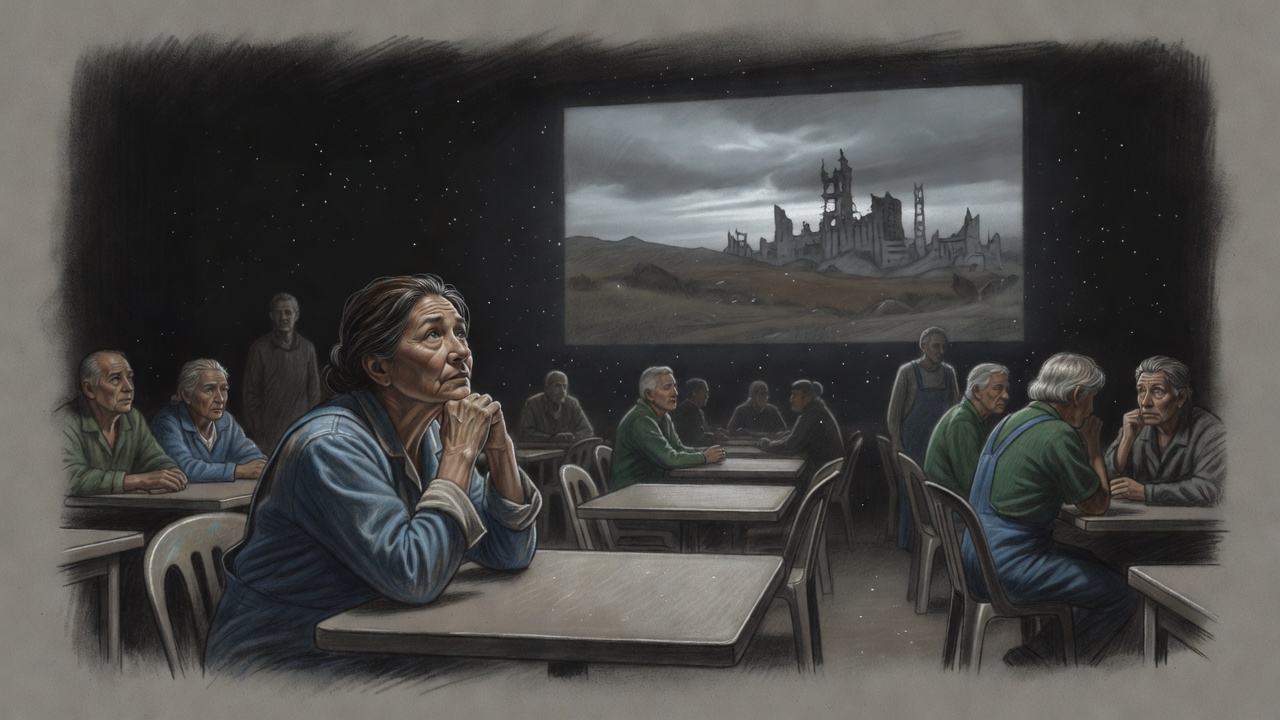
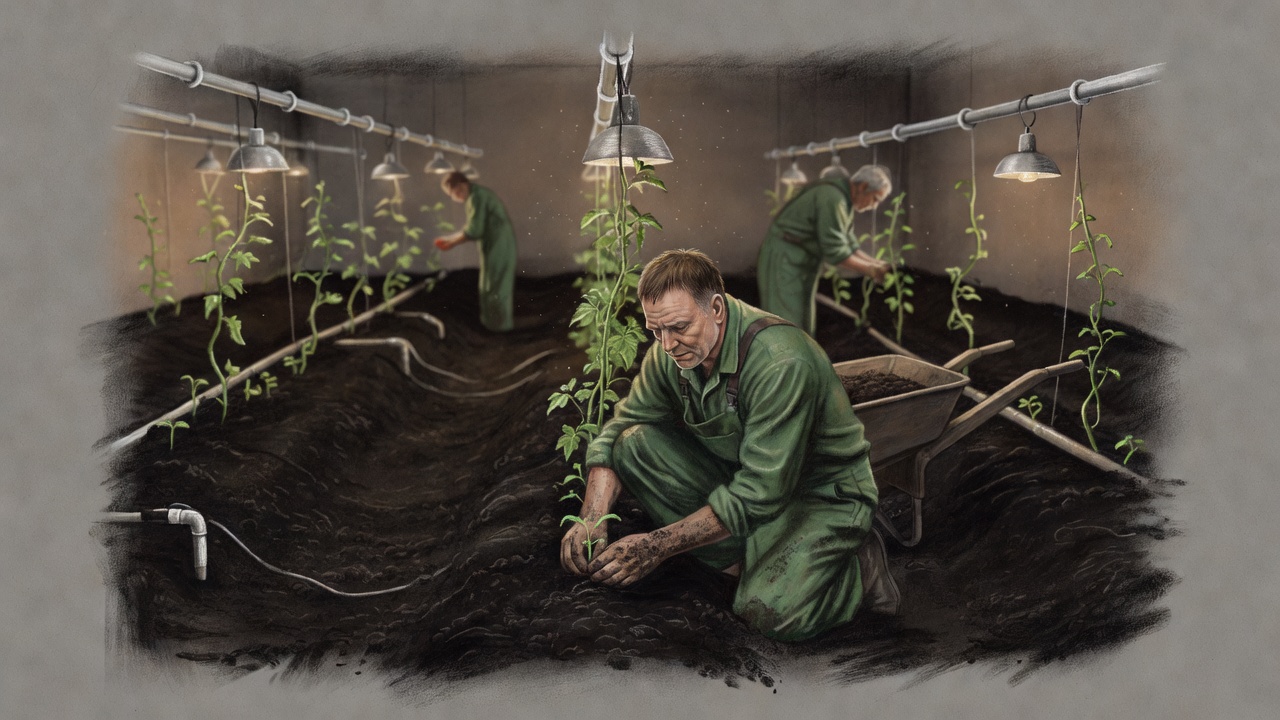
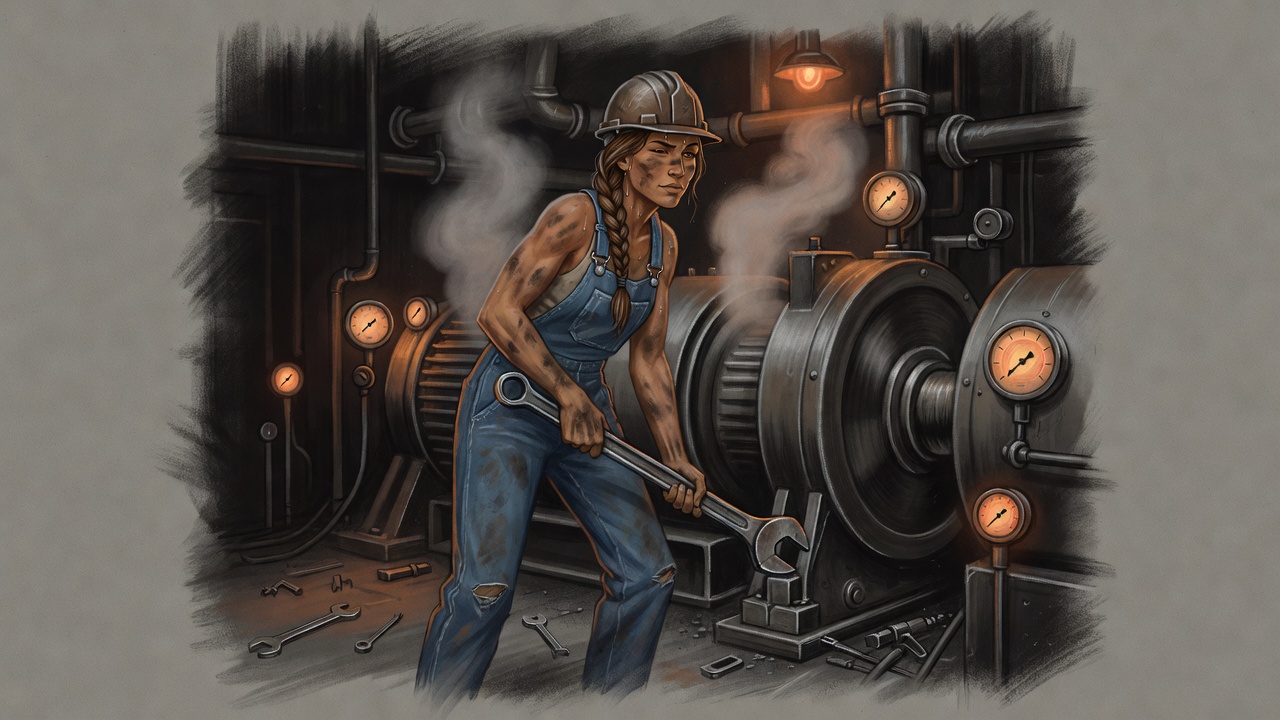
Read from the top, the levels the books name make a rough map. Level 1 holds the cafeteria and its wallscreen, the sheriff’s office and holding cell, and at the end of the hall the yellow door of the airlock. The eighth-floor dirt farm takes the dead. There is a nursery on 20. IT sits in the thirties, behind a gate on 34 with an ID scanner. Elsewhere in the shaft lie hydroponic farms and a bazaar. Lower down come Supply, whose manufacturing floor lies some thirty flights above Mechanical; a lower dirt farm on 126; and, behind a gate at 140, Mechanical itself: the generator and its dynamo, a control room with a window on the generator floor, the oil well and refinery that fuel them, groundwater pumps below the water table, and old Walker’s electronics workshop. Beneath it all is a small mine that Mechanical and Supply run together.
You can tell a stranger’s trade at a glance: Mechanical wears blue, IT silver, farmers green, porters white, doctors pale red; the sheriff wears a brass star. When Mechanical climbs to war in Wool, some of its people change into yellow overalls to blend in the mids.
Each third sees the silo from where it stands. The up top treasures the view, and people from below save holiday chits to climb and look at it. Mayor Jahns, climbing home from her long trip down to Mechanical, sees that the down deep has it the other way round:
The point of the silo was for the people to keep the machines running
The Pact, the Order and the Legacy
Three sets of words run the silo. The Pact is its charter, the law everyone knows. It says who chooses whom — the mayor nominates the sheriff — and that one person may not be mayor and head of IT at once, though when a mayor dies the head of IT stands in. It has been amended before, and couples marry in its name. It also rations children: contraceptive implants go in at birth, and a couple who win the lottery have theirs removed and get one year to try. Holston still carries the ticket he and Allison won the year she died. Trades pass from master to apprentice, called a shadow; Juliette shadowed in the down deep, where old Walker yelled at her for wasting a plastic tie and then showed her how to save it.
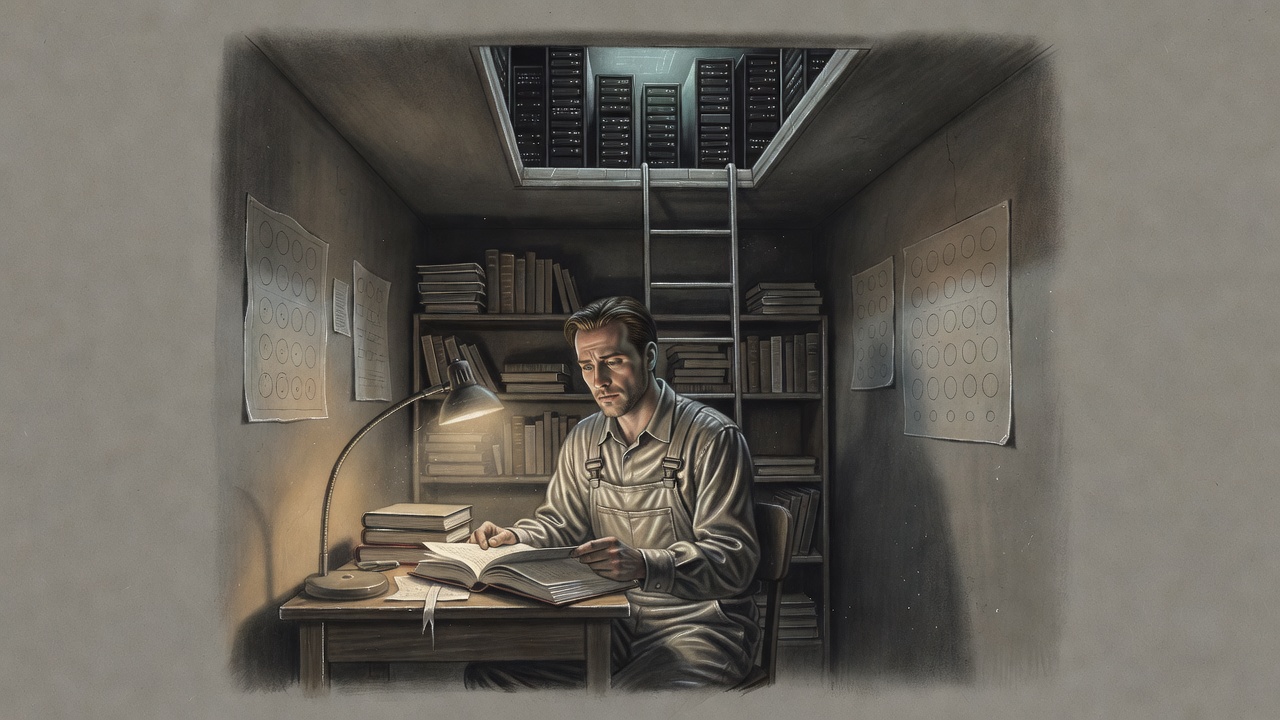
The Order belongs to IT: a manual of rigid rules, bulleted lists and page references for running a silo, kept by the head of IT. When Bernard makes Lukas his shadow in Wool, he sets him to study its sections on insurrections and uprisings. Shift shows where it came from. Senator Thurman gave Donald Keene the Order to memorize before the bombs; the founders’ psychiatrist, Victor, wrote it. Waking into his first shift in Silo 1 in 2110, Donald, under the name Troy, sizes it up:
The Order, he had decided, was more recipe book than operations manual.
The Legacy is the old world’s books, kept in IT on precious paper. It is the truth the silo is permitted, Troy reflects; whatever was not permitted has been cut out of books and memories alike. In Silo 1 the word also names the sleepers in the deep freeze. In Silo 17 the boy who becomes Solo reads the Legacy alone for years; in Dust a girl named Elise cuts pages from it to stitch her own book, and a young preacher burns Silo 17’s copies. Silo 18 knows its Shakespeare as The Tragic Historye of Romeus and Juliette; Juliette’s parents saw it when they first started dating and meant to name their first child from it.
None of it is meant to be questioned, and the questions come anyway. Allison, digging deleted files out of the silo’s machines in Wool, finds that uprisings once came every generation or so, and that their records have been wiped. Shift shows the great one from the inside: Silo 18 in 2212, seen through a young porter named Mission Jones. Silo 1 resets that silo rather than killing it — reduce the population, wipe the computers and the memories, try again — as, Thurman says, it has done there several times before. The silos, Donald learns, fall into a fifteen-to-twenty-year cycle of bloody upheaval. The Order is how a head of IT is meant to survive it.
Cleaning
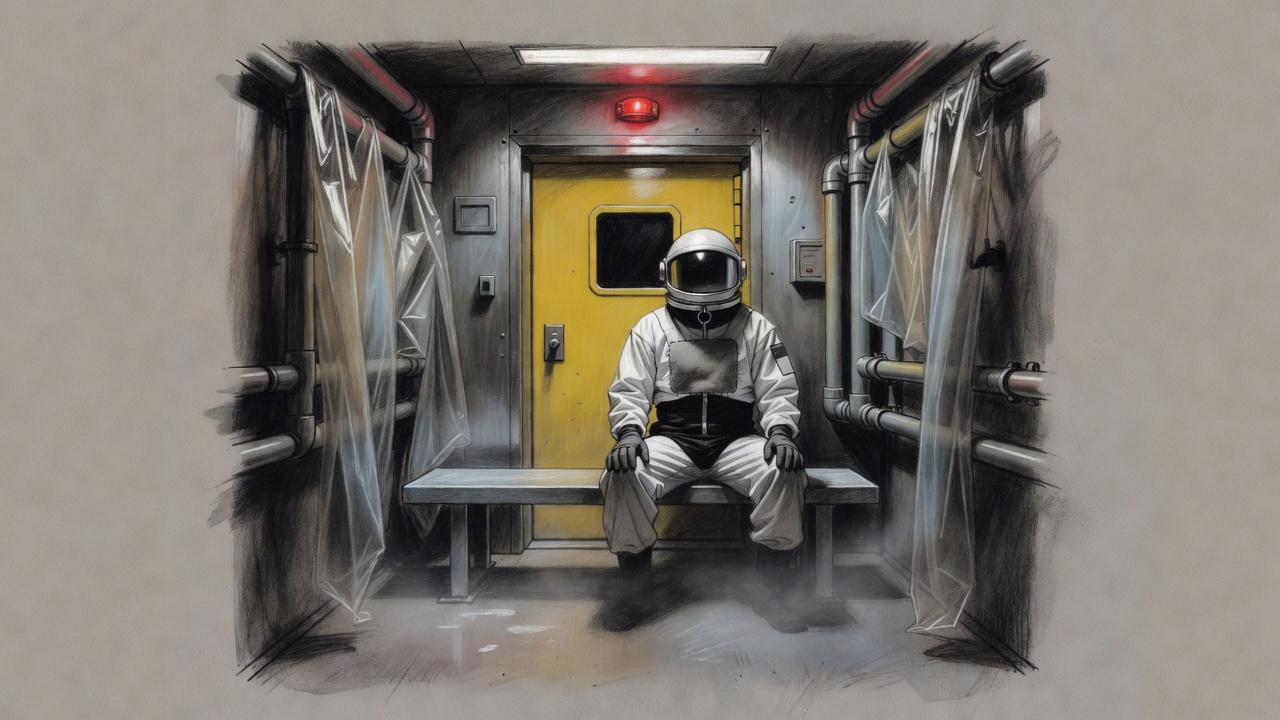
One law is also a sentence. Whoever says they want to go outside is granted it. Holston says it in Wool’s first chapter — “Tell her I want to go outside” — and walks into his own holding cell. Howey’s blurb puts it plainly:
They are given the very thing they profess to want: They are allowed outside.
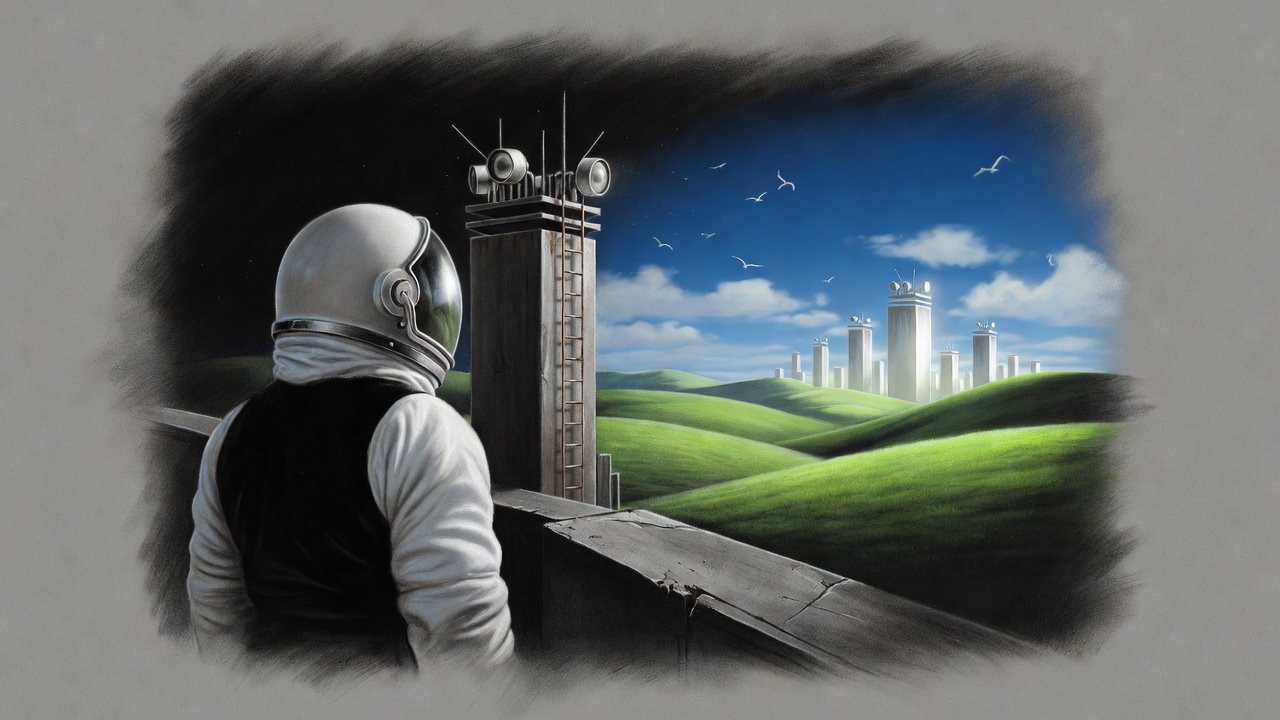
IT’s labs tailor a suit to whoever waits in the cell: a white hazard suit over a black carbon undersuit, sealed joints, double zippers, miles of heat tape, a metal ring collar, and a domed helmet whose visor is silvered on the outside. Pads of wool and spray bottles ride on the suit for the job itself — spray, scrub, wipe — the wool of the first book’s title, along with Mayor Jahns’s knitting. The airlock beyond the yellow door is a steel room with a bench and coloured pipes hung with plastic shrouds. It fills with what the silo calls argon, the outer door opens on a ramp of chipped concrete up to the surface, and afterwards fire scours the room and burns the plastic.
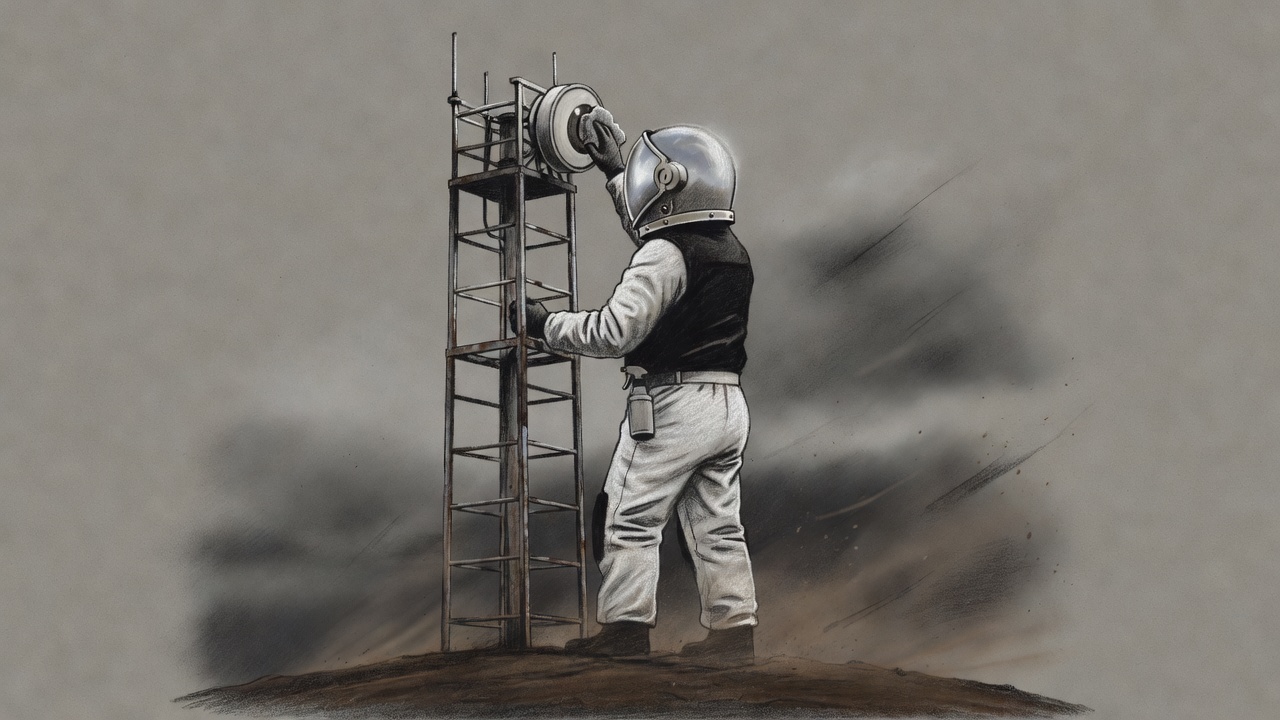
Everyone who sits in that cell swears they will not clean, and then they do. The reason is in the helmet. The visor is not a window but a screen, wired in behind the silver, and at the top of the ramp it shows a paradise: green grass, a blue sky, white clouds, birds, the distant city whole and shining. Sure that the silo has been lied to, the cleaner scrubs the lenses out of pity for the people still inside, then walks toward the green. IT’s heat tape, made to fail, gives way, and the cleaner dies on the slope in full view of the newly cleaned camera. The silo gets its window back, and one more body to prove the outside kills.
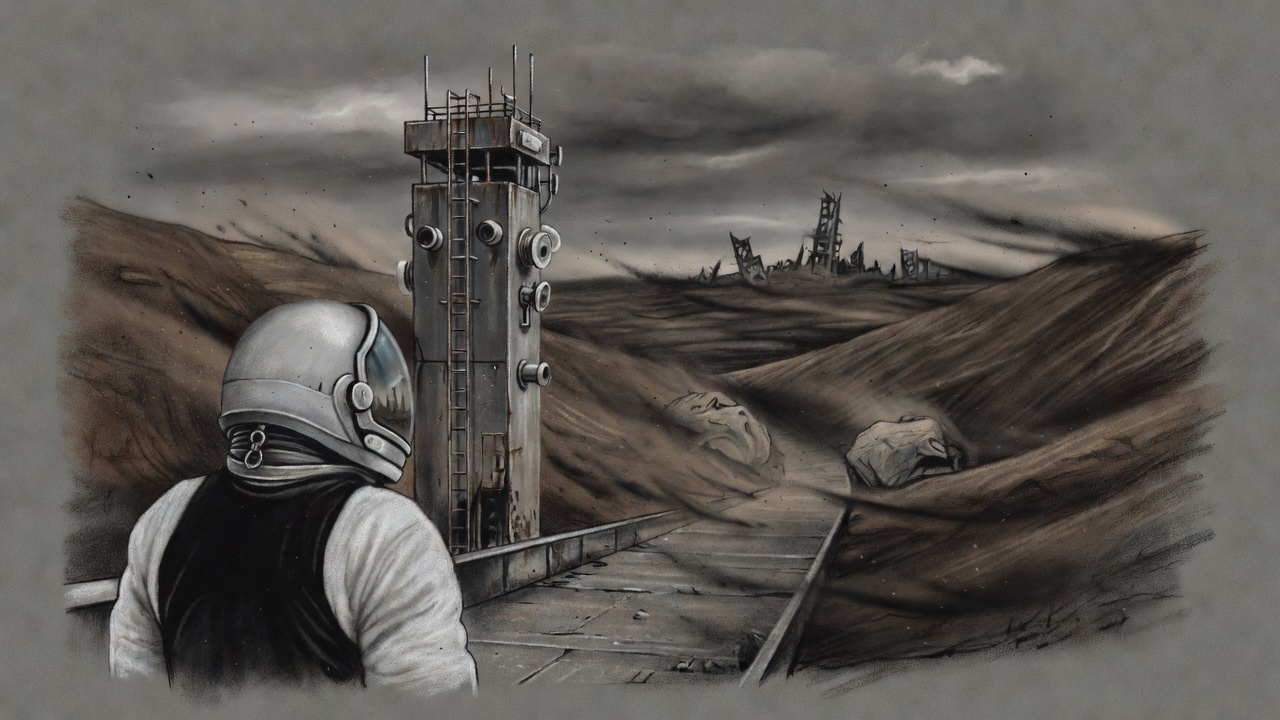
The picture has an edge. Out at the horizon the visor’s program simply stops, at a hard line of painted blue, and the real grey clouds and lifeless hills show through. Juliette sees it because she lives long enough: Walker calls in his favours with Supply, Supply skins her suit in Mechanical’s tape instead of IT’s, and she refuses to clean — no one ever had before — and walks over the hill. In Dust she exposes the last trick. The “argon” that floods the airlock is not argon at all but the poison itself, a dose of the machines that keep the outside deadly, let out with every cleaning.
Fifty silos and Silo 1
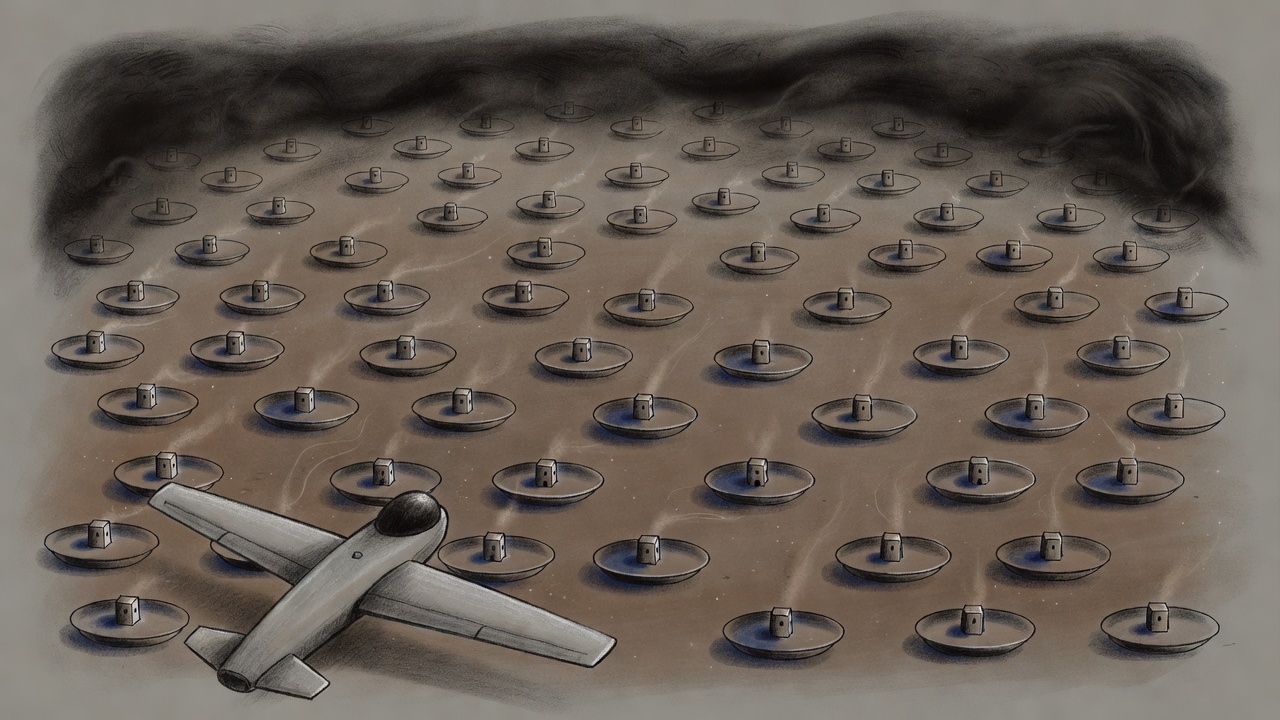
Wool leaves the rest as hints. Bernard answers to someone in Silo 1 on a headset in the server room; the hidden room’s wall schematics show a whole field of silos, some crossed out in red; Solo tells Juliette that silos were once towers for keeping seed, and that the people inside are the seeds, put there for the bad times. Shift fills in the rest.
In 2049 Senator Paul Thurman hands a freshman congressman who trained as an architect, Donald Keene, a job: design an underground shelter for workers at CAD-FAC, a facility in Fulton County, Georgia, to contain the world’s spent nuclear fuel. The specs call for a bunker to house ten thousand people for at least a year. The facility is a cover. Beneath it go fifty silos, World Order Operation Fifty — W.O.O.L., the L a Roman fifty. In 2052 a national party convention camps on the ground above them, one state’s delegation over each silo. Bombs fall on Atlanta, and the crowds are herded underground.
The reason comes out later. Erskine, a nanotechnologist who built medicine too small to see, knew that self-replicating weapons of the same kind were already loose. With Victor and Thurman he chose to end the world first: the bombs were for show, the real killing done invisibly in the air, while the silos kept a remnant underground and the world outside, as Erskine puts it, was “being reset.” Five hundred years was the plan.
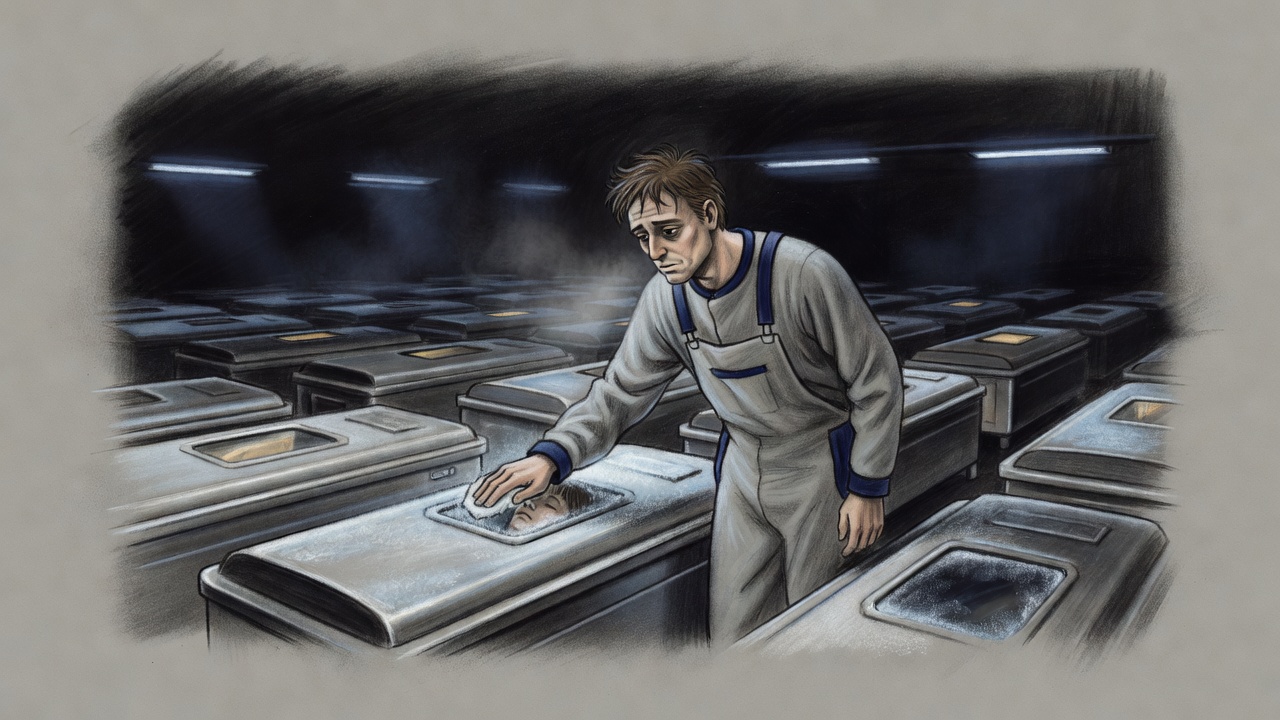
Silo 1 runs the others. Its men wake from the deep freeze for six-month shifts, then go back under; its women and children are left asleep, as on a lifeboat. Each shift begins with pills to forget, and Donald, who resists them, is told on a later shift that the medication is in the water anyway. Silo 1 has a security force in silver, reactor crews in red, an armory of drones with a lift to the surface, and a reactor that powers the servers that watch every silo.
When a silo fails, Silo 1 ends it, by the Order. In 2110 Troy plays solitaire while Silo 12 collapses, then orders the canisters fired into its airlock and crosses it off the chart in red. Silo 40 hacks the system and goes dark. Silo 17 rises in 2312; Silo 1 gasses it and sends the codes to collapse it, but the silo stands, and a sixteen-year-old hidden in its server room, Jimmy Parker, lives on to become Solo. In 2345 Donald finds a founders’ memo filed under “The Pact” and sees what the design is for. Only one silo is ever to be let out; the rest, and Silo 1 with its sleepers, are meant to die. Donald’s verdict: “It’s a suicide pact.”
The world outside
What the wallscreen shows is true as far as it goes: low brown hills, a grey sky, dark clouds, and on the horizon the broken towers of a crumbling city. The silo’s top lies in a scooped-out bowl with the land rising on every side, and in the middle stands the sensor tower, eight or nine feet of steel and concrete with a rusted ladder and bulging fish-eye lenses. The cleaners lie on the slopes where they fell. Over the rise, in another bowl, another tower stands above another silo, 17, its ramp heaped with the bodies of people who came out and tried to get back in.
The first sign that the dead country ends comes from Silo 1. In 2345 a drone flown out past the silos sends back blue sky and green grass before it dies, and in Dust Donald’s sister, Charlotte, a drone pilot, flies another out over a sea of real grass. Each silo, it turns out, hides a digging machine, a tower of tunnelling machinery, and the map in Silo 1 draws red lines from silo after silo to one spot marked SEED. Juliette uses Silo 18’s digger to bore through to 17, then reads the layout of 17’s server room as a map of the silo field.
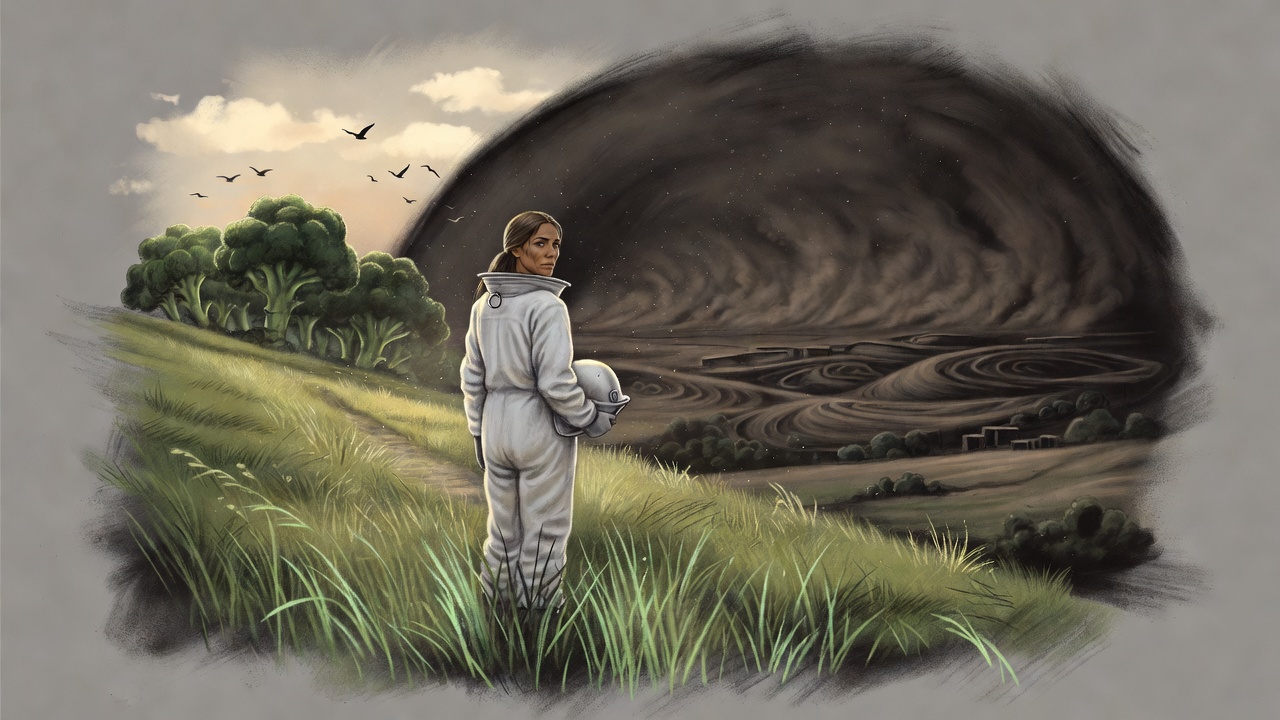
At the end of Dust the survivors of two silos walk out together in cleaning suits, tethered by air hoses and sharing bottles of oxygen. Brown and grey drain out of the view, a bird circles in open sky, and they break out of the wall of dust into grass past their knees. Looking back from the last ringed hill, Juliette sees that the deadly cloud is a dome over the silo field and nothing more. Ahead is a forest like the ones in the Legacy books. Her father unlatches his helmet first and breathes. Howey has said the poison was only ever meant to hang over the silos; everywhere else, nature went on.
The Seed is a concrete tower in the tall grass with a flat roof of silver panels, half covered in vines, which still feed it power. Juliette opens its door with the dynamite she carried to use on Silo 1. Inside are twenty levels packed so tight they feel like seven: clothing, tools, canned food, soil, sealed bags of seeds. At the bottom, where twin stairwells end, an empty cavern on bare rock waits as a landing place for a digger.
Here was the seed of a new beginning.
Howey has called it the fifty-first silo.
The silo at a glance
| Place | Level | What happens there | Book |
|---|---|---|---|
| The sensor tower | the surface, at the top of the ramp | the silo’s only eyes on the world; cleaners scrub its lenses with wool | Wool |
| Cafeteria and wallscreen | 1 | the one view of the outside; pilgrims climb to see it clean | Wool |
| Sheriff’s office and holding cell | 1 | whoever asks to go outside waits here | Wool, Dust |
| The airlock | 1, behind the yellow door | suits, “argon”, the outer door, the fire | Wool, Dust |
| The dirt farm | 8 | the dead are buried to feed the soil | Wool |
| A nursery | 20 | one of the silo’s nurseries; children come only by lottery | Wool |
| IT and the server room | 34 | the servers; the radio to Silo 1 | Wool, Dust |
| The hidden room | 35, under the server room | the Legacy, the Order, schematics of the silos; Solo’s hideout in 17 | Wool, Shift, Dust |
| The mids deputy | the dead center of the mids | a station with a cell; by protocol, a night’s stop for the condemned on the way up | Wool |
| Supply | some thirty flights above Mechanical | a manufacturing floor; rifles milled for the uprising | Wool |
| The down-deep deputy | 120 | Hank’s station | Wool |
| The lower dirt farm | 126 | the down deep’s farm | Wool |
| Mechanical | from the gate at 140 to the bottom | the generator, the oil well, the pumps | Wool, Dust |
| The mine | beneath the lowest level | run by Mechanical and Supply | Wool, Dust |
| The digger | beyond Mechanical’s outer wall | the buried machine that bores through to Silo 17 | Dust |
| Silo 1’s deep freeze | Silo 1 | the sleepers between shifts; the women and children | Shift, Dust |
| Silo 1’s armory and reactor | Silo 1 | drones, the drone lift, the reactor that runs the servers | Shift, Dust |
| The Seed | beyond the dome of dust | seeds, soil and stores for starting over | Dust |
Continuity notes
- 2052 — the silos sealed after the bombs; Silo 1’s women and children frozen, its men on shifts (Shift).
- 2110 — Silo 12 terminated from Silo 1, on Troy’s order (Shift).
- 2211—2212 — Silo 40 hacks the system and goes dark; Silo 18’s Great Uprising, after which Silo 1 resets it rather than ending it (Shift).
- 2312 — Silo 17 rises and is gassed; the collapse codes fail, and Jimmy Parker, sixteen, survives hidden in its server room, later calling himself Solo (Shift).
- 2345 — Juliette walks over the hill to Silo 17; Mechanical’s uprising in 18; Donald, woken in Thurman’s place, runs Silo 1 (Wool, Shift).
- Dust — Silo 18 is gassed after the dig to 17; Donald destroys Silo 1 and dies with Thurman; the survivors of 17 and 18 walk out to the Seed. Howey has said the remaining silos live on, free of Silo 1.
Notes
- Counting the years. Shift’s chapter headers give the outside dates used here (2049, 2052, 2110, 2212, 2312, 2345); Solo’s chapters add “Year Twelve” and “Year Thirty-Four”, counted from Silo 17’s fall. A fan timeline that dates Silo 18’s events to 2352 contradicts the printed headers.
- Terms. Wikipedia calls the release of the poison into a failing silo “the Safeguard”, as the TV series does; this companion did not find that word in the books and says termination instead.
- The levels on the diagram are the ones the books state; everything between them is left blank on purpose.
- On screen, not in the books. Apple TV’s Silo is made to feel nearly a mile deep (its ten thousand people, though, are in Shift’s specs); it adds contraband “relics” from before, armed raiders and the Freedom Day festival, none of which this companion found in the books. Walker becomes a woman, Martha Walker. Its great digging machine lies in a void beneath Silo 18, believed to have dug the silo itself; the books’ digger is a tunneller buried beyond Mechanical’s outer wall. The season pages have the rest.